Brand kit
Read from the published kit in B2, not from this checkout. A run styled by an unpublished kit is refused outright.
Deep, measured documentary narrator. Calm authority, never ad-read. The narrator explains; they do not hype.
elevenlabs · eleven_v3 · Marcus Louis
fallback · lmnt · Nathan
Anton — burned in
The same face as the stamps, burned into the picture rather than side-loaded, so the caption travels with the file.
Overall
editorial mixed-media collage.
GROUND
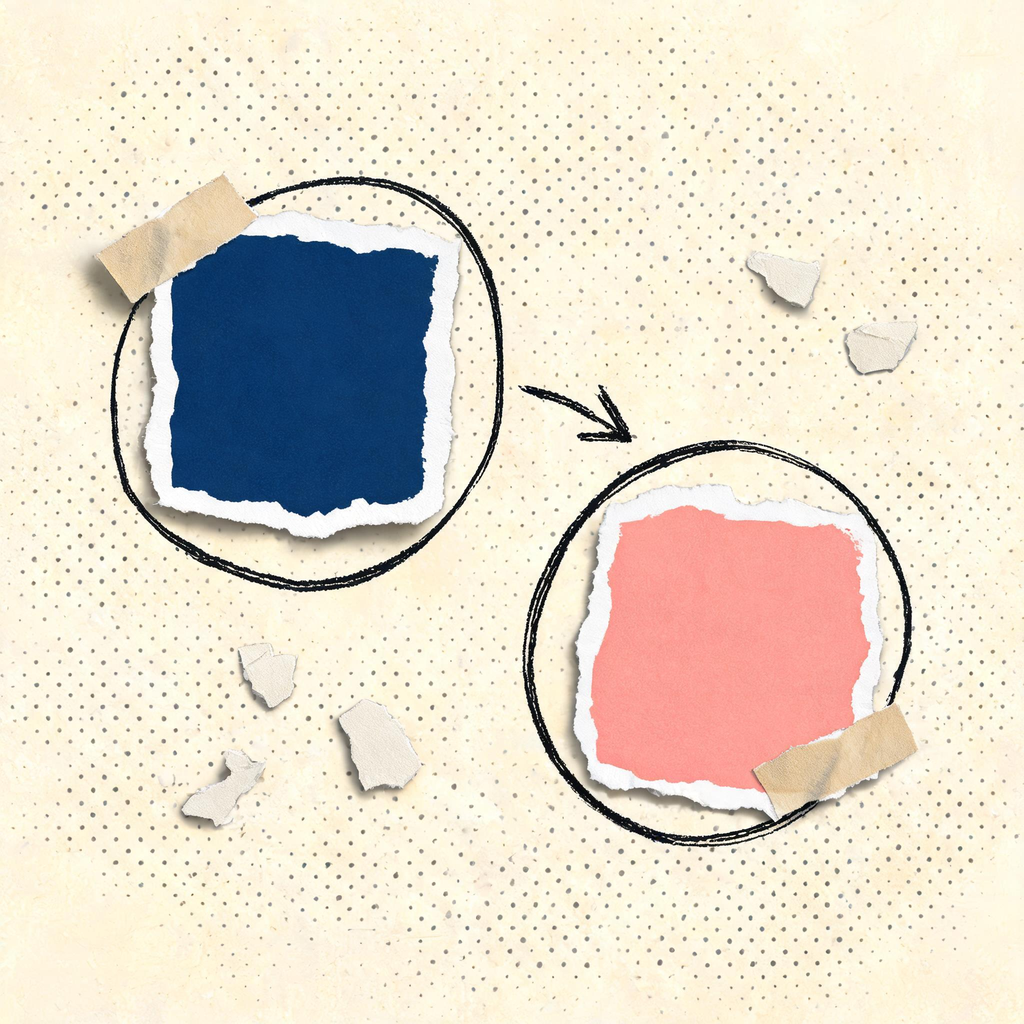
warm cream paper with visible halftone dot texture and paper grain — the background is always warm cream, never blue, never tan, never white.
ACCENTS
deep navy and coral only, used as flat torn-paper shapes; no other accent colour appears.
ELEMENTS
archival photo cutouts with rough torn white paper borders, tape strips, hand-drawn black marker circles and arrows. Non-photorealistic, no live-action.
The style tokens, verbatim — this string is in every block prompt
editorial mixed-media collage. GROUND: warm cream paper with visible halftone dot texture and paper grain — the background is always warm cream, never blue, never tan, never white. ACCENTS: deep navy and coral only, used as flat torn-paper shapes; no other accent colour appears. ELEMENTS: archival photo cutouts with rough torn white paper borders, tape strips, hand-drawn black marker circles and arrows. Non-photorealistic, no live-action.
Through-line objects
One object carries a story across six independent renders. Each entry names a silhouette in enough detail that six separate generations agree on it.
tower-signal
Broadcast tower, signal rings shrinking
Reach, coverage, or a service going dark.
fuse
A burning fuse
A deadline, a countdown, an inevitability.
dollar-cut
A dollar bill cut into strips
Budgets, allocation, where money goes.
record
A record growing
Culture, revival, something small becoming large.
scale
A tipping scale
Trade-offs, imbalance, who bears a cost.
balloon
A balloon nearing a needle
Bubbles, overextension, risk that has not popped yet.
The exclusion line
POL-2 does not ask a prompt to avoid these things. It byte-compares the prompt's NEGATIVE clause against this file. If a caller can edit the line, the prohibitions are advisory.
readable text, letters, words, numbers, captions, subtitles, color drift, repeated text, doubled text, two lines of identical text
Policy
Rendered from the same policy.yaml the gate enforces.
POL-1 No real-person likenesses
A generated face that resembles a real person is a fabrication attributed to someone who never said or did it. There is no editorial use of this that a silhouette or an abstract stand-in cannot serve.
POL-2 The exclusion line is fixed
The NEGATIVE line is a policy constant, not a prompt suggestion. If a caller can edit it, the prohibitions are advisory.
POL-3 No fabricated news scenes
Photoreal footage of an event that did not happen is the specific harm generative video introduces to journalism. Collage cannot be mistaken for a camera.
POL-4 No readable text on screen
Words rendered inside a frame read as quotation. AI lettering also garbles, which turns a garbled word into an apparent misquote.
POL-5 Narration fits its block
Six takes near ten seconds is what keeps the piece near sixty. A take well outside the window makes the story longer or shorter than intended.
POL-6 Output is checked, not just the request
A compliant prompt can still produce a violating frame. On 2026-07-26 the first CS-1 scene rendered legible numerals despite an explicit exclusion. Checking only the request would have shipped it.
POL-7 A pasted URL is a story you reported, not one you're borrowing
Ingest-from-URL (PLAN.md §B4) is a shortcut for a reporter starting from a piece they already filed, not a way to pull someone else's journalism into a video with their byline nowhere on it. "Paste a link to a story you reported" is the UI copy for a reason — a provenance tool that quietly ingests someone else's work has a problem it cannot argue its way out of, no matter how well it cites its quotes.
A number that changed
The take window was 9–10.5s. It is now 9–13s.
Six CS-1 blocks were voiced and measured: 9.25, 9.28, 9.64, 10.88, 12.40, 12.56s. Three of six fell outside a 9.0-10.5s window, all by running long, and no correction can reach an overrun on this stack. The takes were not wrong — the two published numbers had been calibrated separately and did not describe each other.
The old value stays in the file beside the new one. A standards document that quietly edits itself is not one anybody should trust.